

Table of Contents
- How Do Graphic Designers Attract Customers?
- How Photoshop Helps Graphic Designers Get Clients?
- Can You Make Money with Photoshop in the USA?
- Frequently Asked Questions
In the ever-evolving landscape of 2026, the world of graphic design has shifted from simple decoration to strategic communication. As businesses scramble to capture the dwindling attention spans of digital-native audiences, the demand for high-tier designers has never been higher. But with more competition than ever, how do you stand out?
How Do Graphic Designers Attract Customers?
Attracting customers in 2026 is no longer just about having a “pretty” portfolio; it is about proving you can solve business problems through visual strategy. The most successful designers today use a multi-channel approach to build a consistent pipeline of leads.
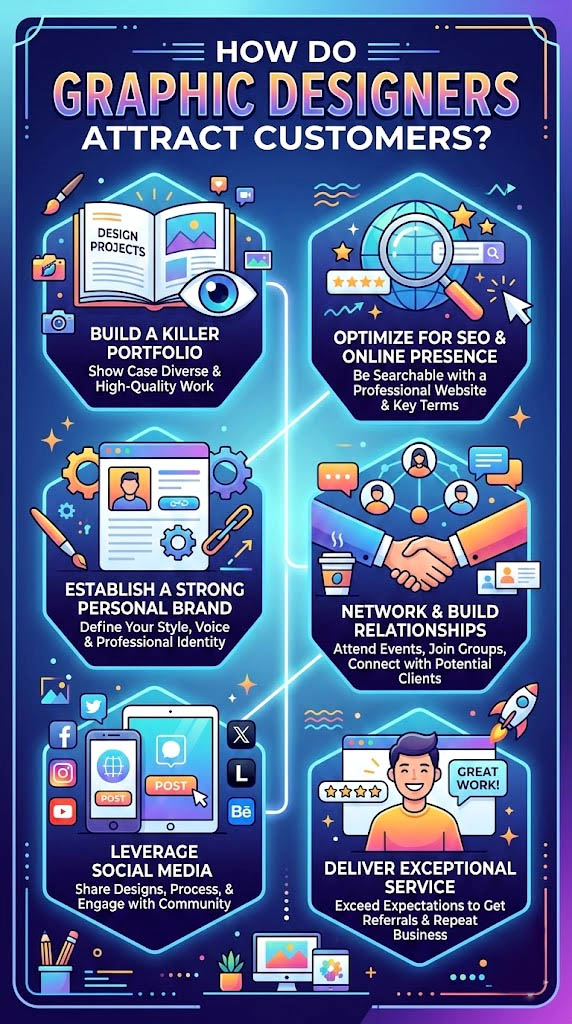
- The Power of the Niche: The “generalist” designer is becoming a thing of the past. To attract high-paying clients, designers are specializing in specific industries, such as eco-tech branding, e-commerce motion graphics, or immersive AR (Augmented Reality) interfaces. By becoming an expert in a niche, you stop competing on price and start competing on value.
- Case Studies Over Samples: Clients in the USA are looking for results. Instead of just showing a finished logo, successful designers are publishing “Process Stories.” These explain the client’s problem, the strategic design thinking applied, and the measurable result (e.g., “This redesign led to a 20% boost in social media interaction”).
- Leveraging Social Proof and “Micro-Interactions”: Utilizing platforms like LinkedIn and Behance to share micro-tutorials or “behind-the-scenes” clips of your workflow builds trust. It shows potential customers that you aren’t just pushing buttons; you are a master of your craft.
- Networking in the “Real” World: While digital presence is vital, 2026 has seen a resurgence in local networking. Attending industry-specific trade shows—not just design conferences—allows you to meet business owners who desperately need your help but don’t know where to look.
How Photoshop Helps Graphic Designers Get Clients?
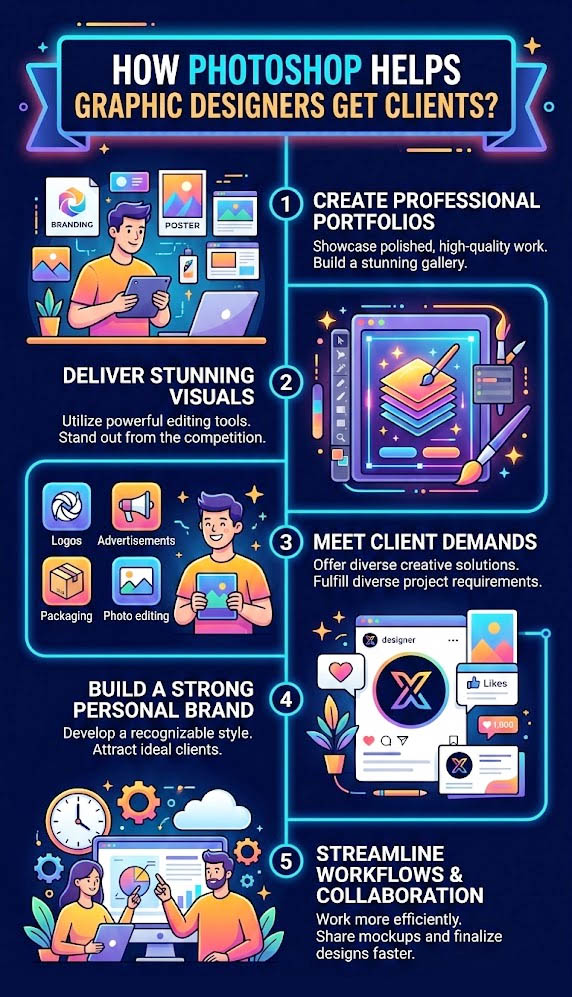
While new AI-driven tools have entered the market, Adobe Photoshop remains the industry gold standard for client acquisition. It is the “Swiss Army Knife” that transforms a basic idea into a professional-grade asset that clients are willing to pay for.
1. High-Fidelity Mockups
Clients often lack the imagination to see how a flat design will look in the real world. Photoshop allows designers to create hyper-realistic mockups—placing a logo on a glass storefront, a 3D product package, or a high-end billboard. This “visual proof” often closes the deal because the client can see the finished product before it even exists.
2. The “Human Touch” in an AI World
With the influx of generic AI-generated images, clients are craving authenticity. Photoshop’s advanced retouching and layering capabilities allow designers to blend AI efficiency with human soul. Using custom brushes, grain overlays, and “Tactile Craft” techniques, you can create designs that feel “real” and “organic,” a major trend in 2026.
3. Professionalism and File Integrity
When a corporate client in the USA hires a freelancer, they expect files that work. Photoshop’s ability to handle complex color profiles (CMYK for print, RGB for web) and export in various formats (WebP, PSD, PDF) ensures that your work is “production-ready.” This reliability leads to repeat business and referrals—the most valuable form of client acquisition.
Can You Make Money with Photoshop in the USA?
The short answer is yes, and the earning potential is significant. As of early 2026, the average annual salary for a professional skilled in Adobe Photoshop in the United States is approximately $67,334, with top-tier freelance experts earning well over $100,000.
Diverse Revenue Streams
Making money with Photoshop isn’t limited to just “getting a job.” The 2026 economy thrives on diverse income:
- Freelance Platforms: On sites like Upwork and Freelancer, Photoshop experts command rates between $30 and $75 per hour for specialized tasks like high-end photo manipulation, e-commerce product “glamorizing,” and social media asset creation.
- Selling Digital Assets: Many designers supplement their income by selling Photoshop brushes, textures, or “Action” presets on marketplaces like Creative Market or Etsy.
- Content Creation: With the rise of visual platforms, Photoshop masters are making money as “Visual Consultants” for YouTubers and TikTokers, creating high-click-rate thumbnails and channel branding.
The USA Market Advantage
The US market specifically values speed and quality. Businesses here are willing to pay a premium for designers who can navigate the legalities of licensing and provide “Brand consistency” across all platforms. Whether you are in a tech hub like San Francisco or working remotely from Wyoming, your ability to manipulate pixels into profit is a highly liquid asset.
In conclusion, attracting customers is about strategy, Photoshop is your primary tool for execution, and the financial rewards in the USA are limited only by your creativity and willingness to adapt.
Frequently Asked Questions
1. Do I need a formal degree in graphic design to attract high-paying US clients? In 2026, the industry has shifted significantly toward skills and results. While a degree can provide a strong foundation, US clients are primarily interested in your portfolio, your mastery of tools like Photoshop, and your ability to solve their specific business problems. Proven experience and strong case studies often carry more weight than a diploma.
2. How do I choose a “niche” if I like doing everything? Start by looking at your past projects. Which ones did you enjoy most, and which ones brought the best results for the client? You don’t have to give up other types of design forever, but your marketing should focus on one area (e.g., “Photoshop Expert for E-commerce”) to make you the obvious choice for those specific clients.
3. Is Photoshop enough, or should I learn AI design tools too? Think of Photoshop as your foundation and AI as an assistant. Clients pay for the professional finish and precision that only Photoshop provides. However, learning to integrate AI into your Photoshop workflow (like using Generative Fill for rapid prototyping) will make you faster and more competitive in the fast-paced US market.
4. How do I set my freelance rates for US-based projects? Rates vary based on complexity, but as mentioned, specialized Photoshop work often commands $30–$75 per hour. Instead of guessing, research the “market rate” for your specific niche on platforms like Upwork or LinkedIn. Always consider the value you are providing—if your design helps a company sell $10,000 worth of products, charging $500 for that design is very reasonable.
5. What is the best way to handle “Brand Consistency” for a client? The best way is to create a Style Guide using Photoshop and other Creative Cloud tools. Ensure you use the same color hex codes, font families, and image filters across all assets. Providing a client with a consistent visual language makes you indispensable and leads to long-term retainer contracts.
6. How much should I charge for 3D and “Spatial” design work? With the rise of AR and spatial computing (like Apple Vision Pro and Meta Quest 3), 3D design is a high-demand niche. In the USA, 3D Photoshop compositing and spatial UI design typically command rates of $80–$150 per hour. If you are creating high-fidelity 3D product mockups for “e-commerce glamorizing,” you can easily charge $1,500–$3,000 per project for a full brand system that includes these assets.
7. Does 2026 branding favor “Minimalism” or “Maximalism”? We are currently seeing a trend called “Neo-Brutalism.” It’s a mix of bold, high-contrast colors (like “Cool Blue” or “Electric Slate”) and raw, unpolished layouts. While “Quiet Luxury” (minimalism) is still popular for high-end fashion, the general market is moving toward “Controlled Chaos”—using Photoshop to layer textures, hand-drawn scribbles, and clashing typography to make brands stand out in crowded digital feeds.